
An SMSF property loan is one of the most specialised areas of lending in Australia. Kubaer Finance works alongside your accountant, adviser and solicitor to match your fund with the right lender and get the structure right from day one.

A self-managed super fund (SMSF) lets you decide how your retirement savings are invested, including, in some cases, in property. For business owners, one of the most powerful strategies is using an SMSF loan to buy the commercial premises your business operates from, so the rent you pay builds your own retirement savings.

An SMSF property loan is a specialised loan that lets a self-managed super fund borrow to buy a property. Unlike a regular home loan, the property isn't bought in your personal name. The borrowing must follow a specific superannuation and trust structure called a limited recourse borrowing arrangement (LRBA), where the SMSF is the beneficial owner and a separate bare trust holds legal title. Standard home loans and investment loans can't be used, because super law restricts how a fund can borrow and hold assets. The loan is only one piece of the puzzle: the structure has to be correct before the contract is signed, and many borrowers get tripped up at this early stage.


A limited recourse borrowing arrangement is the legal structure that allows an SMSF to borrow to acquire a single acquirable asset, such as a commercial property. Super law generally restricts borrowing, and the LRBA rules create a narrow exception that protects the rest of the fund's retirement savings. "Limited recourse" means that if the loan defaults, the lender's claim is generally limited to the property bought under that arrangement, not the fund's other assets. That's why lenders treat SMSF loans differently: their security is more limited, the structure is more complex and compliance mistakes can affect enforceability. Lenders usually ask members for a personal guarantee as well.

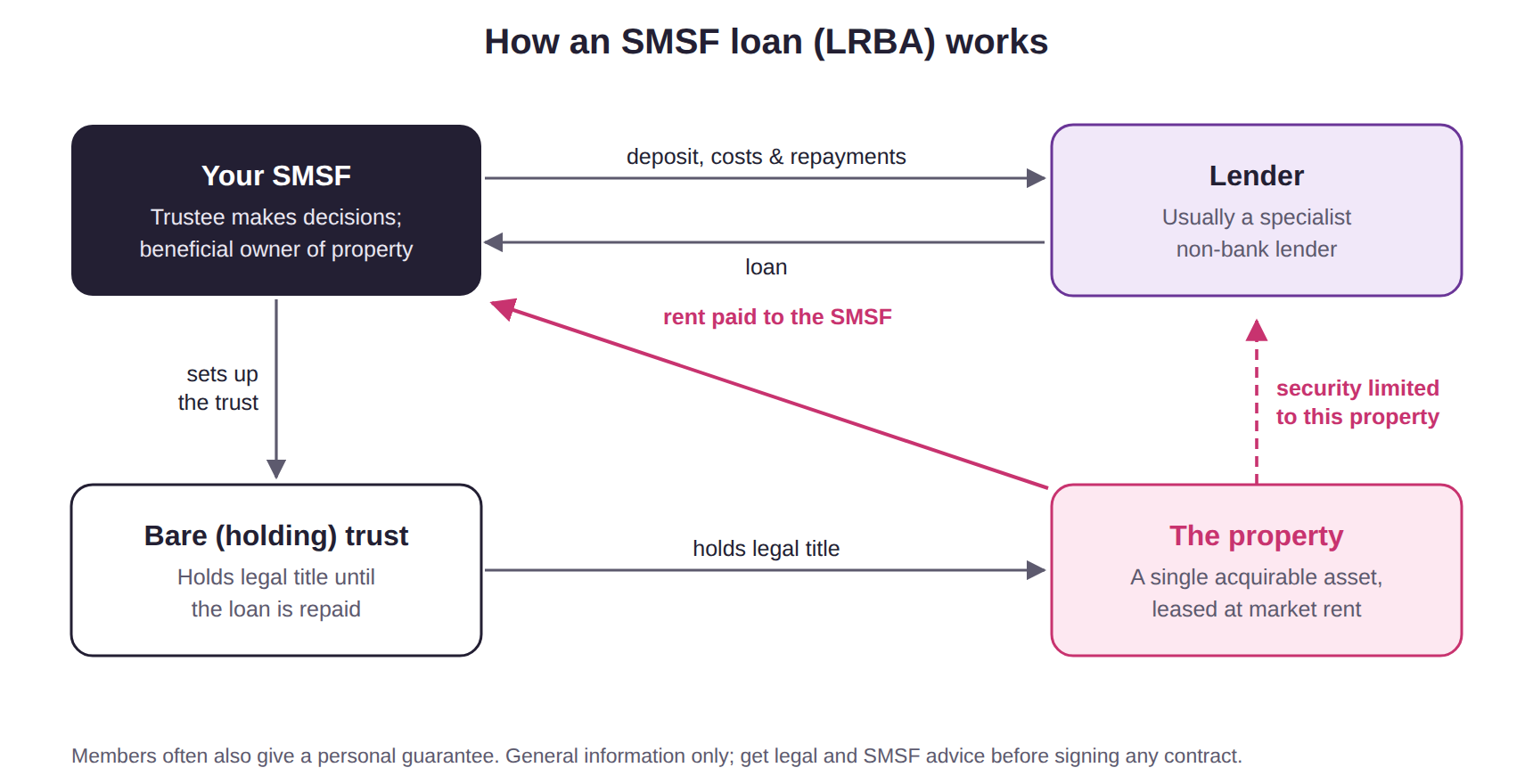
An SMSF can buy business real property, which is land and buildings used wholly and exclusively in a business, and lease it to a member's own business. The business pays rent to the SMSF, wealth builds inside super, and the premises can remain a retirement asset over time. Business real property can also be bought from a related party at market value, which isn't allowed for residential property. Everything must be on arm's length commercial terms: market rent, a proper written lease and rent actually paid on time. Lenders are usually stricter with commercial SMSF loans, with lower LVRs, stronger income evidence, larger liquidity buffers and a close look at the lease and the strength of the tenant business.

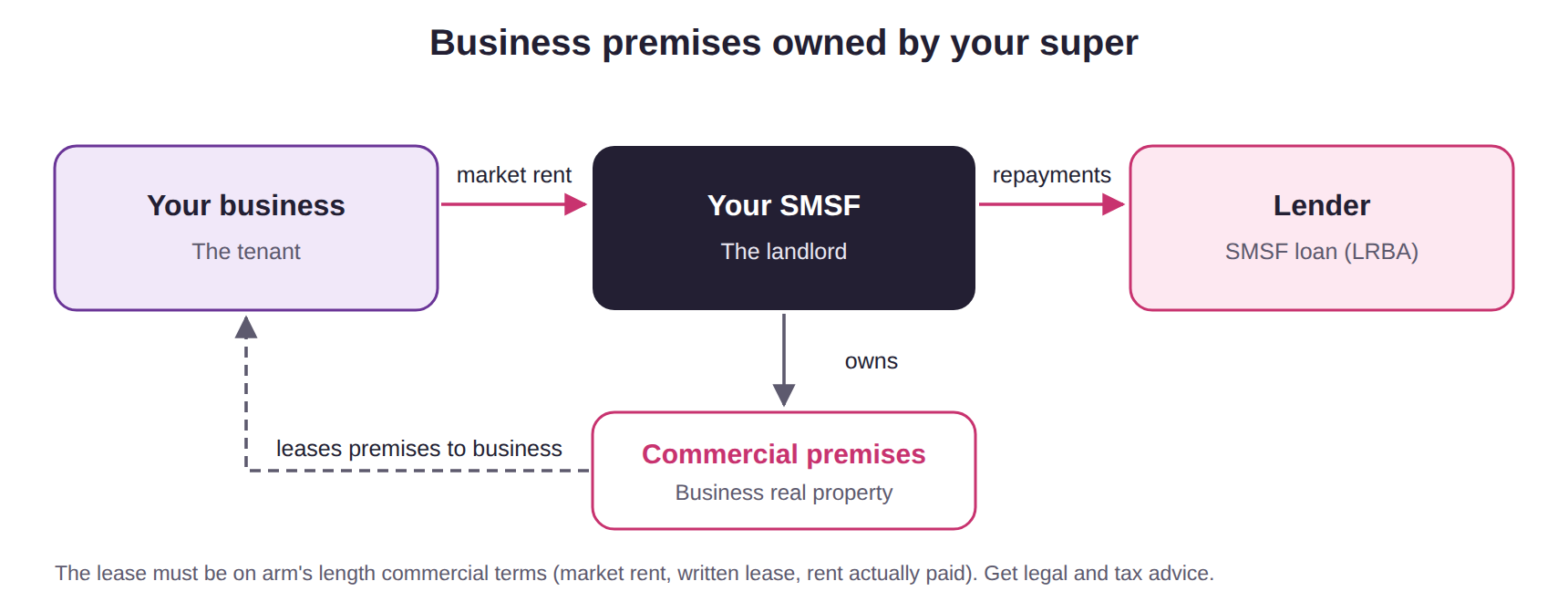
Since 10 August 2026, SMSFs can't take out a new loan to buy residential property. An SMSF can still buy residential property with its own cash, and existing residential SMSF loans can continue and be refinanced. Contracts exchanged before 10 August 2026 may proceed to settlement under transitional rules. The residential rules haven't changed: you, your spouse and other related parties generally cannot live in or rent an SMSF residential property, and it can't be bought from a related party. It is for investment purposes only, not lifestyle use.
Property in an SMSF may benefit from concessional tax treatment. In accumulation phase, rental income is generally taxed at up to 15%, and capital gains on assets held for more than 12 months receive a one-third discount, an effective rate of 10%. In retirement phase, earnings on assets supporting a pension can be tax-free, up to the transfer balance cap ($2.1 million in 2026–27). The 2026–27 Budget changes to negative gearing and the capital gains discount apply to individuals, trusts and partnerships, not super funds. Members with total super balances over $3 million may pay extra tax on realized earnings under the Division 296 rules from 1 July 2026. These benefits depend on the fund being compliant and the strategy suiting your situation, so speak to your accountant.

If your SMSF already has a loan, refinancing may lower the rate, improve the terms or replace a lender that's leaving the market. Existing residential LRBAs are grandfathered under the new rules and can still be refinanced, as long as the refinance doesn't fund a new acquisition. SMSF refinancing still needs care. The new loan must keep the same LRBA structure and bare trust, and fewer lenders offer SMSF refinances, so we'll check which lenders will accept your fund and property before you apply.
SMSFs can no longer take out new loans (LRBAs) to buy residential property. Existing residential SMSF loans are grandfathered and can be refinanced, and contracts exchanged before 10 August 2026 may still proceed under transitional rules. SMSFs can still borrow to buy business real property, such as commercial premises.
Check whether a property strategy suits your fund, including balance, contributions, property type, borrowing capacity, risk and liquidity.
Trust deed, trustees or a corporate trustee, bank account, TFN and ABN, all compliant from the beginning.
Explain why property fits the fund's objectives, considering risk, return, diversification, liquidity and the ability to pay expenses and benefits.
A separate holding trust is set up before the purchase to hold legal title.
Confirm it qualifies under the 2026 rules and meets lender policy. Lenders may restrict specialized commercial assets, certain postcodes and unusual titles or zoning.
The lender reviews the fund and the members, including balance, contribution history, rental income, member income, debts, credit file and liquidity after settlement.
The contract must be in the correct purchasing name for the trust structure.
Supported by rent, employer and salary sacrifice contributions, personal contributions within the caps, and cash reserves.
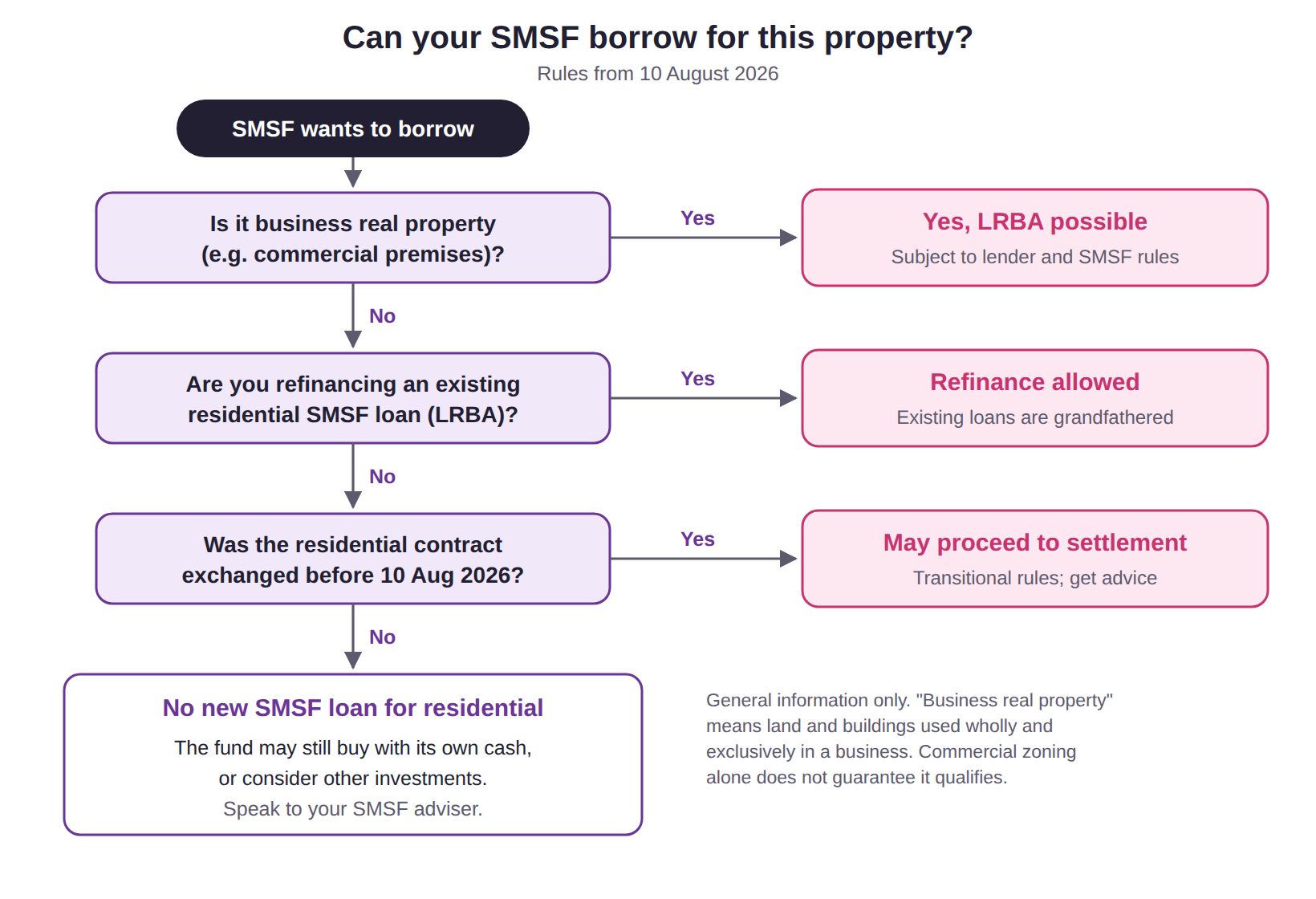
| Party | Role |
|---|---|
| SMSF trustee | Manages the fund and makes investment decisions. Many lenders prefer or require a corporate trustee |
| SMSF | Provides the deposit and costs, receives the rent, makes repayments and benefits from the asset |
| Bare trustee / holding trustee | Holds legal title to the property until the loan is repaid |
| Lender | Provides the finance; recourse is limited to the property |
| Members (as guarantors) | Often give personal guarantees to the lender |
| Property type | Typical maximum LVR | What it means |
|---|---|---|
| Commercial (business real property) | Around 60% to 70% | Deposit of 30% to 40% plus costs |
| Residential (existing loans being refinanced) | Around 70% to 80% | New residential LRBAs are no longer allowed |
| Related-party loans (ATO safe harbour) | Up to 70% | 2026–27 safe harbour rate for real property: 9.35% |
Lenders see SMSF loans as higher risk because the structure is complex, their recourse is limited, compliance mistakes can create legal issues, and SMSFs have fewer fallback options than personal borrowers.
| Feature | SMSF loan | Standard investment loan |
|---|---|---|
| Lender pool | Limited, mostly specialist non-bank lenders | Broad, including the major banks |
| Interest rates | Usually higher | Usually lower |
| LVR | Lower | Higher |
| Structure | Complex (LRBA and bare trust) | Simpler |
| Security | Limited recourse to one property | Full recourse |
| Flexibility | Lower (limits on improvements and redraw) | Higher |
| Residential purchases | No new loans from 10 August 2026 | Allowed |
| Cost item | What it covers |
|---|---|
| SMSF setup fees | Establishing the fund, trust deed and corporate trustee |
| Bare trust setup | Holding trust deed and trustee establishment |
| Legal fees | Contract review, lender legal work and trust advice |
| Accounting advice | SMSF structure, tax and compliance guidance |
| Financial advice | Suitability and strategy advice |
| Loan costs | Application, valuation, legal and settlement costs |
| Stamp duty | State-based duty on the purchase |
| Ongoing accounting and audit | Annual SMSF compliance, independent audit and ATO levy |
| Property costs | Rates, insurance, maintenance and management |
A cheap-looking property strategy can become an expensive SMSF strategy very quickly if the fund is undercapitalised.
An SMSF property loan can be a powerful tool when it suits the investor, the fund and the long-term retirement strategy. It isn’t a standard loan, and it isn’t a beginner-friendly shortcut into property. It needs the correct legal structure, a realistic deposit and liquidity position, strong compliance, a suitable property and a team that understands both lending and super rules.
For the right investor, especially business owners who want to own their premises, SMSF property investment can be a smart long-term strategy. Speak with an SMSF lending specialist before making any property decisions inside super.
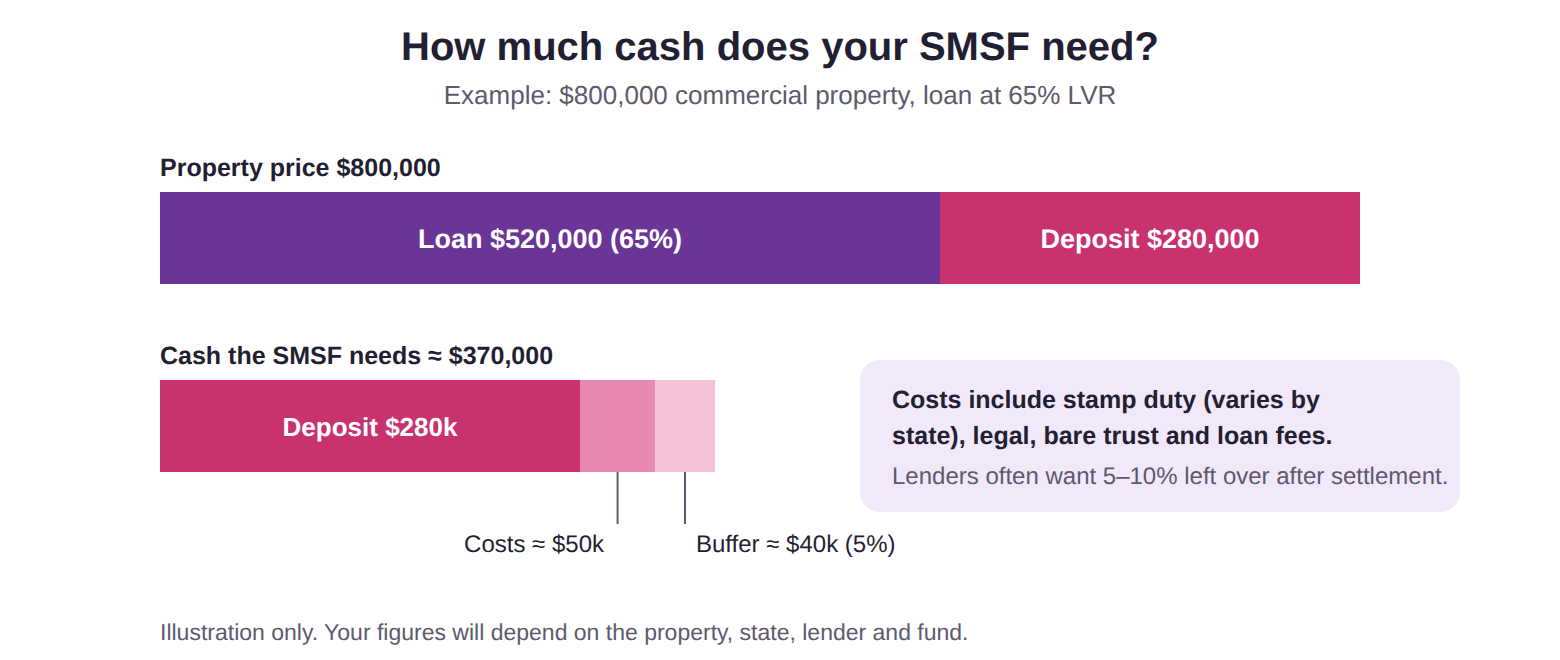
A fund that spends nearly all its cash on the deposit and costs can quickly run into trouble with repayments, repairs or a vacancy. Keep a buffer of at least 5% to 10% of the property value in the fund.
Yes, if the purchase meets super law and lender requirements. From 10 August 2026, an SMSF can only take out a new loan for business real property, such as commercial premises. It can still buy residential property with its own cash.
Not with a new loan. New LRBAs for residential property have been banned since 10 August 2026. Existing residential SMSF loans can continue and be refinanced, and contracts exchanged before that date may proceed under transitional rules.
A limited recourse borrowing arrangement, the structure an SMSF must use to borrow to buy property.
The holding trust that holds legal title to the property under an LRBA until the loan is repaid.
Yes, if the property is business real property and the lease is on arm's length commercial terms, with market rent paid on time.
No. Members and related parties generally cannot live in or rent residential property owned by the SMSF.
Many lenders prefer at least $150,000 to $200,000, and more for commercial purchases. A larger balance gives the fund more room to cover costs and keep a buffer.
Often 30% to 40% of the price for commercial property, plus purchase costs and a liquidity buffer.
The lender pool is small (the big four banks don't offer SMSF property loans), the structure is more complex and the lender's security is limited to one property.
Yes. Lenders assess the members behind the fund and usually ask for personal guarantees.
Care is needed. Borrowed money can be used for repairs and maintenance, but improvements must be paid from the fund's own cash and must not turn the property into a different asset.
Yes, including grandfathered residential loans, although fewer lenders offer SMSF refinances.
Those changes apply to individuals, trusts and partnerships, not super funds. Members with super balances over $3 million may be affected by the separate Division 296 tax from 1 July 2026. Check with your accountant.
The sale proceeds go back to the SMSF. The tax depends on how long the fund held the property and whether members are in accumulation or retirement phase.
Typically business owners, high-income earners, professionals and experienced investors with strong super balances and a long-term plan.
People with lower balances, weak cash flow, little diversification or short-term expectations.
Getting excited about the property before getting the SMSF structure, advice and lender sorted properly.
Tell us about your fund and plans and we'll be in touch within one business day. There's no obligation and no cost for an initial chat.



Kubaer Finance helps working families and migrants in Adelaide secure home, car, and investment loans with personalised guidance.