
If you haven't reviewed your loan in a while, there's a good chance you're paying more than you need to. Refinancing means moving your loan to a new lender, or a better product, to get a sharper rate, more useful features or a structure that suits your life today.
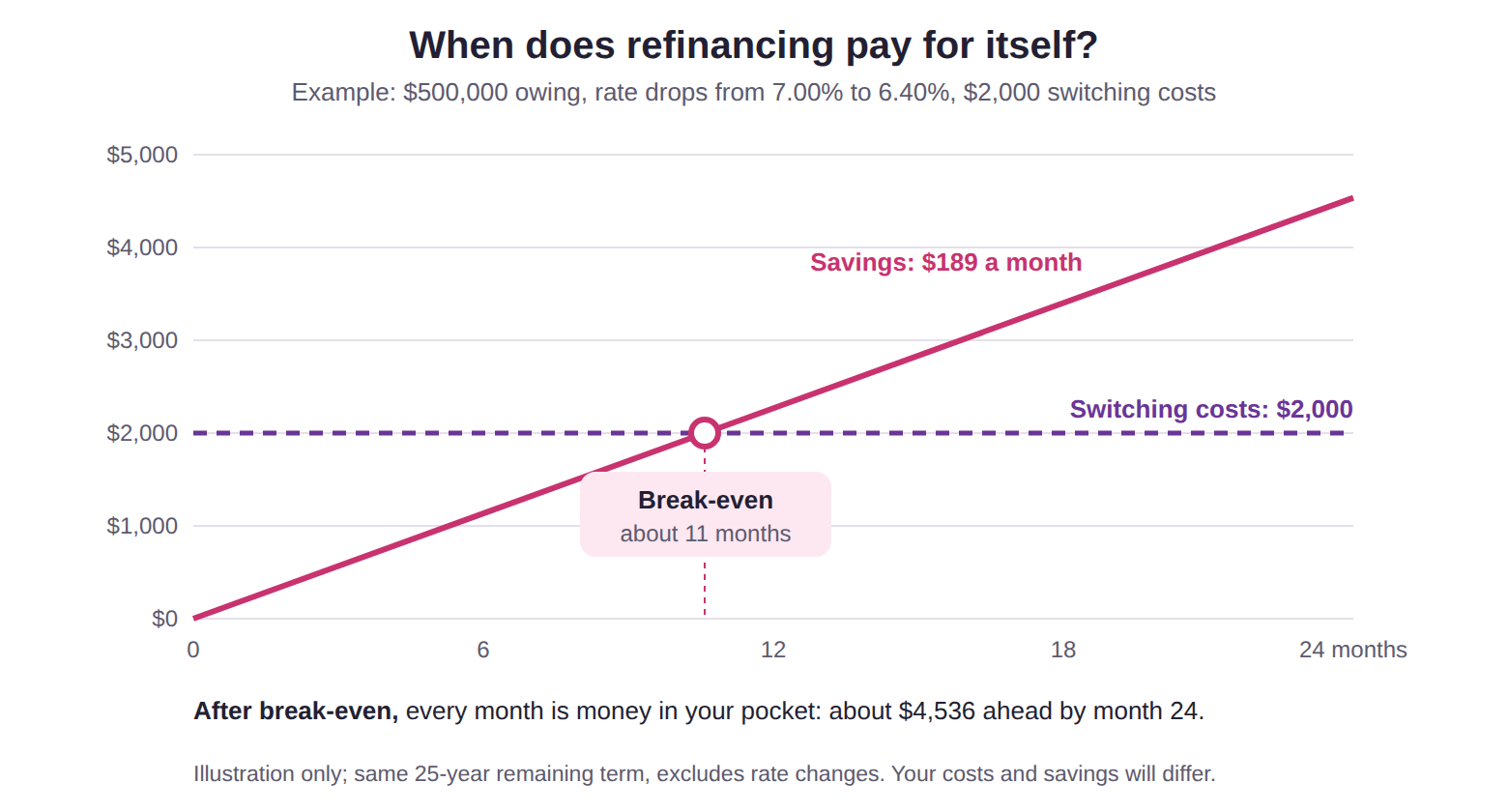
Even a small rate difference adds up. On a $500,000 home loan with 25 years left, moving from 7.00% to 6.40% cuts repayments by about $189 a month and can save around $56,700 in interest over the remaining term, as long as you keep the same loan term. Savings only count once your switching costs are covered. In that example, $2,000 of costs would be recovered in about 11 months. We always show you the break-even point before you decide, so you know the move is worth it.

This is one of the most common questions people ask, and the answer depends on your situation. But here are clear signs that now might be the right time for you:
| Signal | What it means |
|---|---|
| Your fixed rate period is ending | You are about to roll onto a variable rate that may be much higher |
| You haven’t reviewed your loan in 2+ years | You are likely paying more than necessary, as lenders often offer better rates to new customers |
| Other lenders are offering lower rates than yours | You could reduce your repayments by switching or asking your lender to match |
| Your credit score has improved | You may now qualify for better loan products |
| Your property has increased in value | You have more equity and may access better rates or avoid LMI |
| You are struggling with repayments | Refinancing or restructuring can reduce your monthly repayments |
| You want to pay your loan off faster | A better rate means more of each repayment goes to the principal |

Home loans are the most common loans to refinance because even a small rate cut makes a big difference over 20 or 30 years. Refinancing can lower your rate, add an offset account, switch between fixed and variable, or release equity for renovations. If your loan is above 80% of your property's value, you may need to pay lenders mortgage insurance again, so we check your equity and the latest valuation before you apply. We'll also make sure you don't accidentally reset your loan term and pay more interest overall.

If you took dealer finance in a hurry, or your credit has improved since you bought the car, refinancing could lower your rate and repayments. It can also help you plan for a balloon payment that's coming up. We compare your current loan's payout figure and any early termination fee with the new loan's comparison rate, so you can see whether you'll come out ahead.

Refinancing business debt can lower your interest costs, combine several facilities into one, extend terms to ease cash flow, or release equity from property to fund growth. Business lending is assessed on your trading performance, so up-to-date financials and a clean ATO position help. We'll compare banks and specialist lenders to find the best fit for your business.

If your personal loan has a high rate, a new loan at a lower rate can reduce your repayments or the total interest you pay. Fixed rate personal loans sometimes charge an early termination fee, so we check that first and only recommend switching when the numbers add up.
Rolling credit cards, personal loans and other debts into your home loan can replace several high rates with one lower rate and one repayment. Be careful, though: spreading short-term debt over a 25 or 30 year home loan can mean paying more interest overall. We'll show you how to pay the consolidated amount off faster, for example with a separate split and higher repayments.

Refinancing an investment loan can improve your rate, restructure interest-only and principal and interest splits, or release equity for your next purchase. It needs extra care: mixing personal debt into an investment loan can reduce how much interest you can claim. We'll keep your investment and personal borrowing separate and recommend you confirm the tax side with your accountant.
Lenders count your full card limit as debt, even if you don't use it, so a lower limit can increase how much you can borrow.
Secure a more competitive interest rate, reducing your monthly repayments and saving you money over the life of the loan.
Access features like offset accounts, redraw facilities or the ability to make unlimited extra repayments, which might not be available with your current loan.
Roll multiple debts (e.g. credit cards, personal loans) into your home loan, often at a lower interest rate, simplifying your finances.
Tap into the equity you've built in your home to fund renovations, investments or other significant purchases.
Your income, family size or financial goals might have changed, and your loan should adapt accordingly.
We look at your current rate, fees, features, balance and what you want to achieve.
We compare lenders and work out your savings against switching costs and any break costs.
We prepare one strong application to the lender most likely to approve you at a good rate.
The new lender values your property and issues formal approval.
You sign your current lender's discharge authority so they can prepare to close the loan.
The new lender pays out your old loan and your new repayments begin.
| Cost | Who charges it | What to know |
|---|---|---|
| Discharge fee | Your current lender | Charged for closing your loan, commonly a few hundred dollars |
| Government registration fees | State land titles office | Paid when the new lender registers its mortgage and the old one is removed; amounts vary by state |
| Settlement fee | Your new lender | Some lenders charge it, many waive it |
| Valuation fee | Your new lender | Some lenders charge for a valuation, others provide it free |
| Lenders mortgage insurance (LMI) | Your new lender | If your new loan is above 80% of the property value, you may need LMI again. It can cost thousands and is not transferable |
| Break costs | Your current lender (fixed rate loans) | If you leave during a fixed rate period you may pay break costs. Ask for a quote first |
| Early exit fees | Not allowed on most home loans | Banned on home loans taken out since 1 July 2011. Some car and personal loans may still charge them |
1. A lower rate doesn’t always mean a better loan. Some lenders advertise low rates but charge high fees. Always check:
2. Your loan term may restart. If you refinance into a new 30-year loan, your repayments may drop, but you could pay more interest overall. Keeping your remaining term, or making the same repayments as before, avoids this.

3. Your credit score can be affected. Applying to many lenders directly creates multiple credit enquiries, and too many can lower your credit score. A broker can shortlist suitable lenders first, so you apply once.
4. Banks use different rules. Some lenders accept overtime income and some don’t. Some accept casual income easily and some don’t. That’s why choosing the right lender is critical.
5. Refinancing can affect tax on investment loans. If you refinance an investment loan and mix in personal debt, you may lose some tax deductibility. That’s why investment loans must be refinanced carefully.
| Document | Employee (PAYG) | Self-employed |
|---|---|---|
| Photo ID | ✓ | ✓ |
| Recent payslips | ✓ usually 2 | |
| Tax returns and notices of assessment | Sometimes | ✓ 2 years (low doc options exist) |
| Current loan statements (last 6 months) | ✓ | ✓ |
| Bank and savings statements | ✓ | ✓ |
| Credit card and other debt statements | ✓ | ✓ |
| Council rates notice (for property loans) | ✓ | ✓ |
| Rental statements (investment loans) | If relevant | If relevant |
Lenders assess your employment stability, and a new job or probation period can delay or stop your approval.
A home loan refinance commonly takes 2 to 6 weeks, depending on the lenders involved and how quickly documents are provided. Car and personal loan refinances are usually faster.
Each application adds an enquiry to your credit report. One well-prepared application has little impact, but several in a short time can lower your score. That's why we shortlist lenders before applying.
Yes, but you may pay break costs. Ask your lender for a break cost quote first. Often the best time to switch is when your fixed period ends.
Only if your new loan is more than 80% of your property's value, in most cases. LMI you paid on your current loan is not transferred to a new lender.
Sometimes. Specialist lenders may help, but rates are higher, so we check whether switching still saves you money.
Yes. Many people refinance to release equity for renovations, investing or other large expenses. You still need to show you can afford the larger loan.
It's worth asking. Many lenders will lower your rate to keep you. We can tell you what rate to ask for based on what other lenders are offering.
Lenders still apply a serviceability buffer, so higher rates can reduce what you can borrow. Some lenders have simpler policies for refinancing to a lower repayment. We'll find the ones that suit you.
Book an Consultaiton



Kubaer Finance helps working families and migrants in Adelaide secure home, car, and investment loans with personalised guidance.