

Buying an investment property is one of the biggest financial decisions you'll make, and the loan behind it matters as much as the property. The right structure can improve your cash flow, keep your tax records clean and make it easier to buy your next property.

Most lenders want a deposit of at least 20% of the property's value to avoid lenders mortgage insurance (LMI). Many will lend up to 90% for investors if you pay LMI, which is a one-off cost that protects the lender, not you. You'll also need to cover stamp duty, legal fees and other purchase costs, which vary by state. Your deposit doesn't have to be cash. If you own your home and have built up equity, you can often borrow against it to fund the deposit and costs for an investment property. Many of our clients buy their first investment property this way.


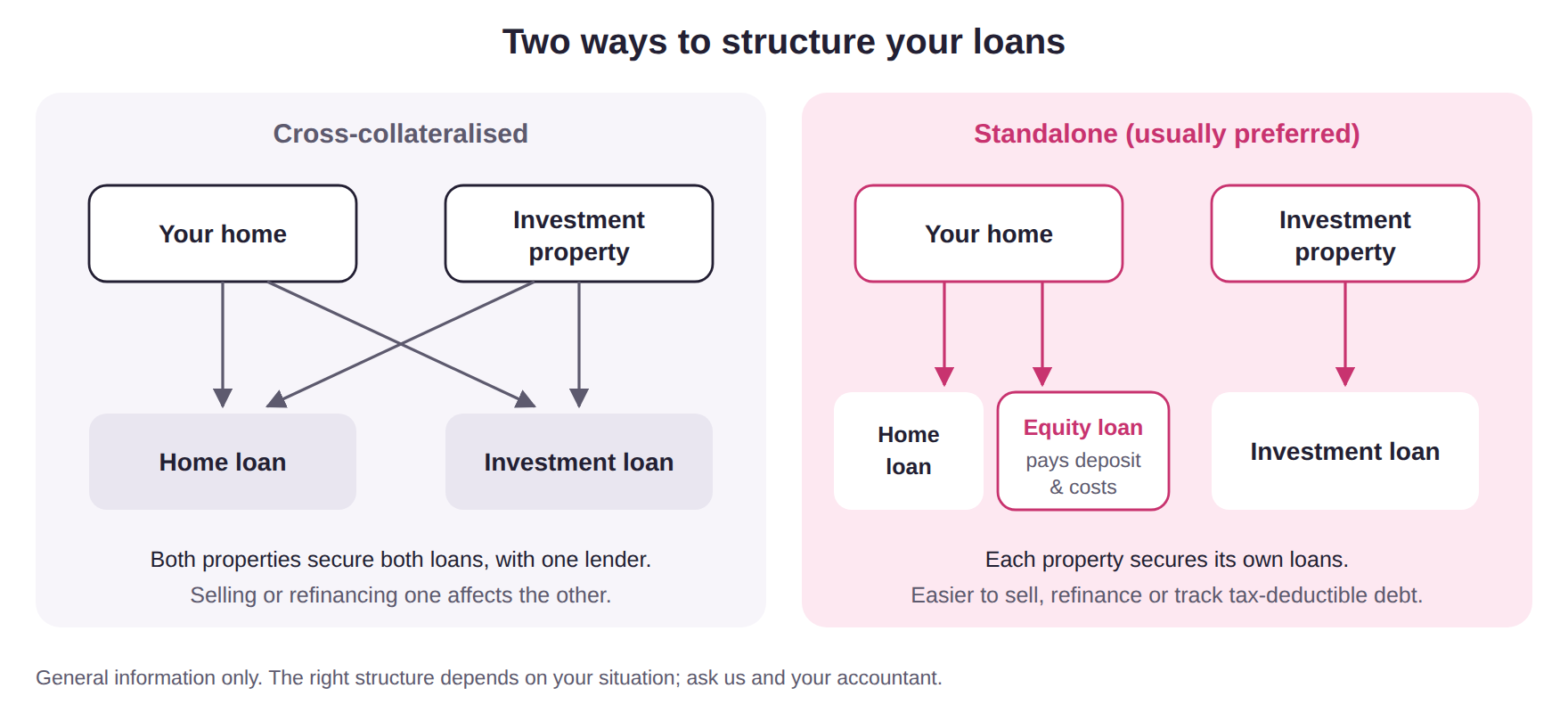
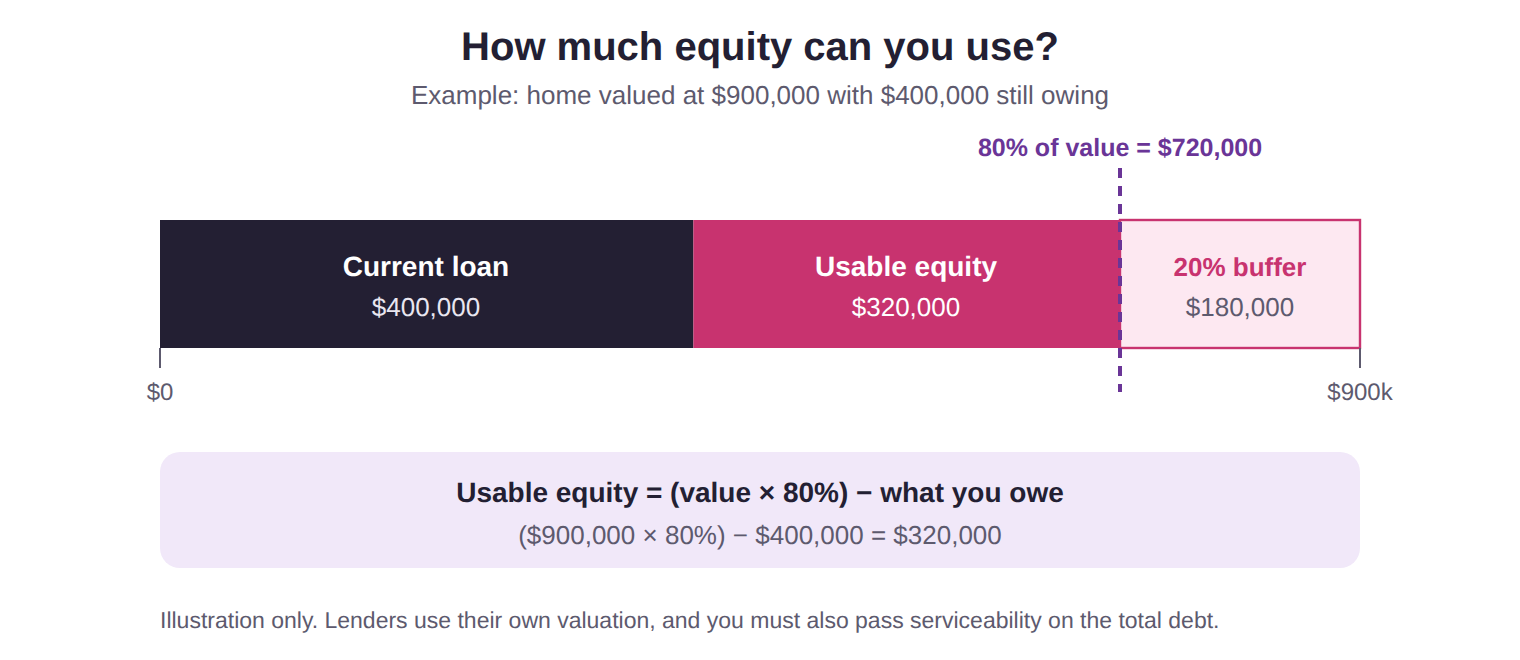
Equity is the difference between what your home is worth and what you owe on it. Most lenders will let you borrow up to 80% of your home's value without LMI, so your usable equity is 80% of the value, minus your current loan. On a $900,000 home with $400,000 owing, that's about $320,000 you could put towards an investment. Usable equity isn't the same as borrowing power. You still need to show you can afford the repayments on your total debt. We usually set up the equity release as a separate loan against your home, used only for the investment deposit and costs, so the interest is easier to track for tax.
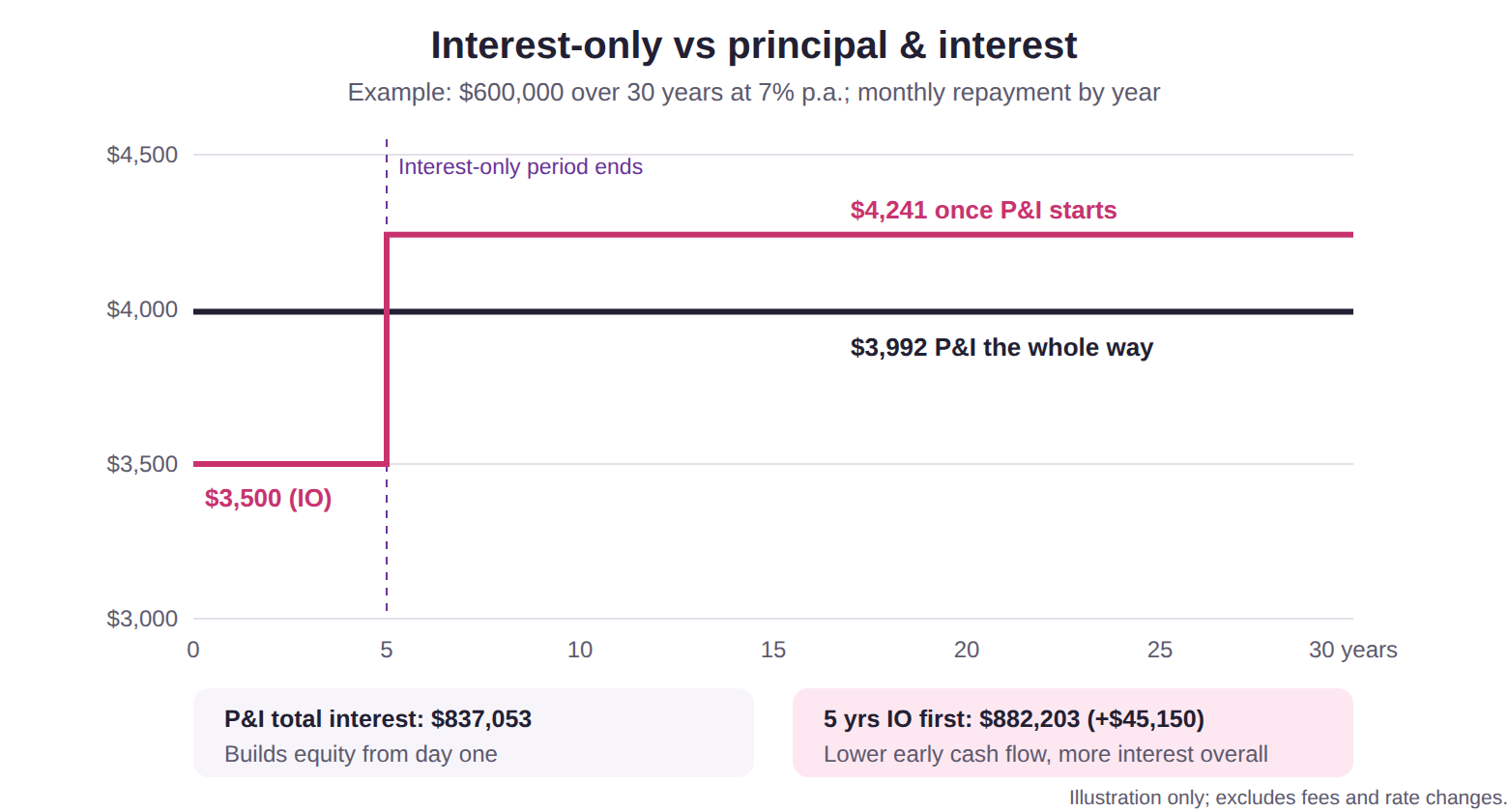
Many investors choose interest-only repayments for the first few years, often up to five, to keep cash flow lower while the property is tenanted. You pay only the interest, so the loan balance doesn't go down, and when the interest-only period ends your repayments rise because you have a shorter time left to repay the full amount. Principal and interest repayments are higher from the start but reduce your debt and usually attract a lower rate. The best choice depends on your cash flow, whether you also have a non-deductible home loan to pay down, and your long-term plan. We'll model both so you can see the difference.

An offset account linked to your investment loan reduces the interest you're charged without reducing the loan balance, and keeps your savings available. If you have a home loan too, it's often better to put spare cash against the home loan first, since that interest isn't tax deductible. Be careful with redraw. Taking money out of an investment loan's redraw for personal spending can mix private and investment debt, which can reduce how much interest you can claim. We'll help you set up your loans so they stay clean, and your accountant can confirm the tax treatment.
The 2026–27 Federal Budget changed how residential investment property is taxed, and these measures are now law. From 1 July 2027, negative gearing for residential property is limited to new builds. If you buy an established property after Budget night (7:30pm AEST, 12 May 2026), rental losses from 1 July 2027 can only be offset against income from residential property, including capital gains, with any excess carried forward. Properties you already owned on Budget night are grandfathered for negative gearing. For capital gains tax, the 50% discount is being replaced for gains made after 1 July 2027 with indexation of the cost base and a 30% minimum tax, while gains made before then keep the 50% discount. New builds can choose either method. These changes can make a big difference to your cash flow, so talk to your accountant before you buy.
Use a separate loan (not a redraw on your home loan) for anything related to the investment, including the deposit and purchase costs. Clean, separate loans make tax time simpler and protect your deductions.
We talk about your goals, budget, how long you plan to hold, and whether you want growth, rental income or both.
We assess your income, expenses and debts, including the serviceability buffer and debt-to-income checks.
We work out how much comes from savings and how much from equity in your home.
We set up separate loan splits, decide on interest-only or principal and interest, and get you pre-approved.
Once you sign a contract, we arrange the valuation and formal approval.
Arrange landlord insurance, a property manager and a tax depreciation report.
| Feature | Owner-occupier loan | Investment loan |
|---|---|---|
| Purpose | Home you live in | Property you rent out |
| Interest rate | Usually lower | Often slightly higher |
| Interest tax deductible? | No | Generally yes, while the property is rented or available for rent |
| Interest-only available? | Limited | Common, often up to 5 years |
| Rental income counted? | Not applicable | Yes, usually 70–80% of it |
| First home buyer schemes | May be eligible | Not eligible |
| Capital gains tax on sale | Main residence usually exempt | Applies; rules change for gains after 1 July 2027 |
| Cost | Generally deductible? | Notes |
|---|---|---|
| Loan interest | Yes | Only on money borrowed for the investment. Rules change for established properties bought after 12 May 2026, from 1 July 2027. |
| Property management fees | Yes | |
| Council rates, water, strata levies | Yes | While the property is rented or available for rent |
| Landlord and building insurance | Yes | |
| Repairs and maintenance | Yes | Fixing wear and tear. Improvements are capital works instead. |
| Land tax | Yes | State-based; thresholds vary |
| Capital works (building) depreciation | Yes, over time | Usually 2.5% a year for eligible construction costs |
| Plant and equipment depreciation | Limited | Generally not claimable on second-hand items in established homes bought after 9 May 2017 |
| Travel to inspect the property | No | Not deductible for residential rentals since 1 July 2017 |
| Stamp duty and purchase costs | No (not immediately) | Usually added to the cost base for capital gains tax |
General information only, not tax advice. Your accountant can confirm what applies to you.
| Document | Employee (PAYG) | Self-employed |
|---|---|---|
| Photo ID | ✓ | ✓ |
| Recent payslips | ✓ usually 2 | |
| Tax returns and notices of assessment | Sometimes | ✓ 2 years (low doc options exist) |
| Bank and savings statements | ✓ | ✓ |
| Statements for existing loans and cards | ✓ | ✓ |
| Current rental statements (if you already invest) | If relevant | If relevant |
| Rental appraisal for the new property | ✓ | ✓ |
| Contract of sale | ✓ | ✓ |
Before you buy, check you could still manage if rates rose further, the property sat empty for a month or two, or a big repair came up. The 2027 tax changes may also reduce the tax benefit on some established properties, so work out your cash flow without relying on a tax refund.
Yes. Most lenders let you borrow up to 80% of your home's value, minus what you owe, without LMI. You still need to show you can afford the total repayments.
Usually 20% to avoid LMI, plus purchase costs. Some lenders accept 10% with LMI. Equity in your home can count as your deposit.
Often, yes. Lenders usually price investment loans slightly higher than owner-occupier loans, and interest-only loans higher again. We compare lenders to find a competitive rate.
Yes for properties you owned on 12 May 2026 and for eligible new builds. For established properties bought after that date, from 1 July 2027 rental losses can only be offset against residential property income, including capital gains. Speak to your accountant about your situation.
It can help cash flow in the early years, but you pay more interest overall and repayments rise when the interest-only period ends. It often suits investors who are also paying down a home loan.
Banks must check you could afford repayments if rates were at least 3 percentage points higher than your actual rate. It reduces how much you can borrow but protects you if rates rise.
Yes, but these structures have their own lending rules, costs and tax outcomes. Get legal and tax advice first; we can then find lenders that support that structure.
An offset reduces interest without reducing the loan balance. If you also have a home loan, it's usually better to offset the home loan first, since that interest isn't deductible.
Yes. Your current home loan can often stay as it is, and your new home becomes the owner-occupied loan. The tax treatment depends on how the original loan was used, so check with your accountant.
Brokers are usually paid a commission by the lender when a loan settles. We'll give you our Credit Guide, which explains how we're paid and any fees, before we help you apply.
Tell us a little about your goals and we'll be in touch within one business day. There's no obligation and no cost for an initial chat.



Kubaer Finance helps working families and migrants in Adelaide secure home, car, and investment loans with personalised guidance.